
A Japanese research team has turned a single atom into a microscopy tool capable of mapping light at resolutions below 100 nanometers — far beyond what traditional optical microscopes can achieve. The breakthrough could accelerate development of quantum computers.
What if the world’s most precise camera wasn’t made of glass or silicon, but of a single atom? That’s essentially what researchers at Japan’s Institute for Molecular Science, National Institutes of Natural Sciences, have built. Their new technique, dubbed the “Atom Camera,” uses one ultracold rubidium atom — cooled to within a whisker of absolute zero — as a scanning probe to map both the intensity and polarization of light at resolutions that conventional microscopes simply cannot match.
The findings, published May 29 in Nature Communications, they represent a meaningful step forward for the quantum computing field, where precise control of laser light at microscopic scales is increasingly critical.
How the Atom Camera Works
At the heart of the technique is an optical tweezer — a tightly focused laser beam that can grip and hold individual atoms the way a pair of tweezers grips a tiny object. First developed by physicist Arthur Ashkin in the 1970s, optical tweezers have become a staple of atomic physics research. In this case, the team used one to trap a single rubidium atom and then physically scan it across a light field with nanometer-scale precision.
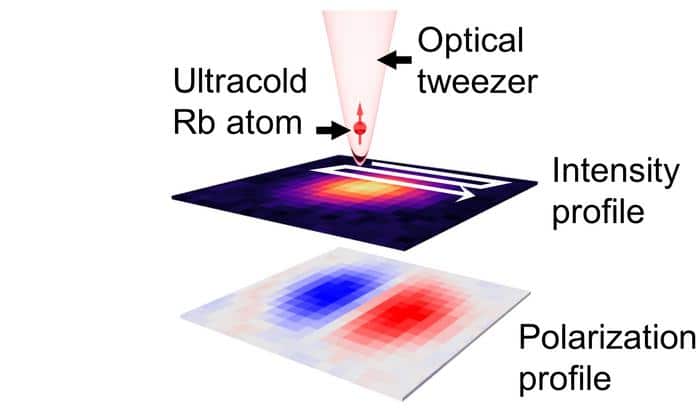
Caption: Conceptual illustration of the Atom Camera. A single ultracold rubidium (Rb) atom trapped in an optical tweezer is spatially scanned to visualize the intensity and polarization distributions of a light pattern.
Credit: Takafumi Tomita
As the atom moved through different positions in the light field, the researchers measured shifts in the energy levels of the atom’s internal spin states. Because those energy shifts respond to both the intensity and the polarization of nearby light, the team was able to reconstruct a detailed map of the light’s properties at each location — essentially building an image one atom-sized data point at a time.
The spatial resolution achieved in the experiment came in below 100 nanometers, significantly exceeding what conventional optical microscopes can resolve. That barrier — known as the diffraction limit — prevents standard light-based instruments from clearly imaging structures smaller than roughly the wavelength of visible light, which is several hundred nanometers. The atom’s positional uncertainty, governed by quantum mechanics, was approximately 25 nanometers under experimental conditions, setting a fundamental floor for how sharp the images can get.
Seeing Polarization, Not Just Brightness
One of the technique’s standout capabilities is its ability to directly image polarization — the directional property describing how a light wave oscillates. While most imaging tools measure light intensity, polarization is far harder to capture at small scales. The Atom Camera demonstrated this by visualizing a subtle phenomenon that occurs when a linearly polarized laser beam is focused tightly through a lens: near the focal point, the beam spontaneously develops regions of circular polarization. This effect had been predicted theoretically but was difficult to observe directly at such fine spatial scales.
For quantum computing applications, that matters. Atomic qubits — the basic units of information in neutral-atom quantum computers — respond differently depending on the polarization of the laser beams used to control them, not just the beams’ intensity. A diagnostic tool that captures both properties simultaneously offers researchers a far more complete picture of what’s happening inside their quantum hardware.
Why It Matters for Quantum Computing
Neutral-atom quantum computers, which trap arrays of individual atoms using optical tweezers and manipulate them with laser light, have attracted significant attention in recent years for their scalability and relatively long coherence times. But operating them reliably demands exquisite control over the laser fields that define the trap geometries and drive qubit operations.
One persistent challenge is that conventional cameras cannot easily be placed inside the vacuum chambers where quantum hardware lives — introducing a sensor risks disturbing the environment-sensitive qubits. Observing light through external lenses, meanwhile, introduces its own distortions called aberrations. The Atom Camera sidesteps both problems by using the atom itself, already inside the apparatus, as the sensor.
The research team, led by Takafumi Tomita, an assistant professor, and Kenji Ohmori, a professor at the Institute for Molecular Science, described the method as a powerful new diagnostic tool capable of directly observing nanoscale optical structures that were previously inaccessible. They noted that characterizing both laser intensity and polarization simultaneously is especially valuable because atomic qubit behavior depends on both.
What Comes Next
Beyond quantum computing, the technique may find applications in any field requiring precise characterization of structured light at small scales — from optical communications to fundamental physics experiments. The method’s reliance on quantum-mechanical properties of a single atom also opens a conceptually new class of measurement instrument, one that operates at the intersection of atomic physics and optical engineering.
The study was conducted in collaboration with researchers from Hamamatsu Photonics Central Research Laboratory and RIKEN.
Source: Institute for Molecular Science