
UC Riverside researchers have created a robot-powered mapping system that shows exactly how much water each tree in an orchard needs. The technology could help farmers survive drought, cut costs and reduce pollution by watering smarter, not more.
In a future of tighter water supplies and harsher droughts, a new robot rolling through citrus orchards in California points to a different way to farm: watering only what truly needs it.
Researchers at the University of California, Riverside have developed a system that creates detailed, tree-by-tree maps of soil moisture, allowing growers to target irrigation instead of soaking entire fields. The work, led by Elia Scudiero, an associate professor of precision agriculture and director of UC Riverside’s Center for Agriculture, Food, and the Environment, is published in the journal Computers and Electronics in Agriculture.
Water management is one of the biggest challenges for farmers in California and other dry regions. Many growers now rely on a handful of buried soil moisture sensors to decide when to irrigate. Those devices can be accurate where they sit, but they are expensive, so only a few are installed across orchards that may hold hundreds or thousands of trees.
Scudiero noted that creates a serious blind spot.
“The information those sensors provide is very limited,” he said in a news release. “It really only tells you what’s happening in the immediate areas where they’re placed.”
Even when a sprinkler or drip system delivers the same amount of water across an orchard, conditions can vary dramatically from tree to tree. One major reason is soil texture. Fine, clay-rich soils hold on to water, while sandy soils let it drain quickly. Two neighboring trees can end up living in completely different underground worlds, even if they receive identical irrigation.
The new UC Riverside system is designed to fill in those gaps.
A robot moves through the orchard, towing instruments that measure a property called soil electrical conductivity. That is a measure of how easily electricity moves through the ground, which is influenced by moisture, salt and clay content. At the same time, fixed moisture sensors already buried in the soil provide direct readings of water content at specific points.
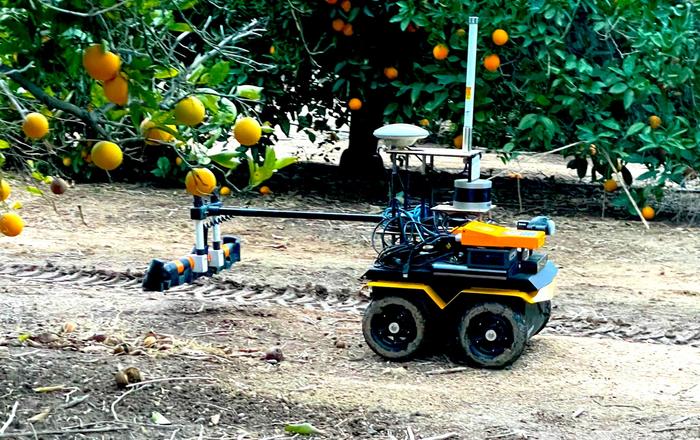
Caption: A robot designed to assist with precision irrigation in action, in a citrus orchard.
Credit: Elia Scudiero/UCR
By combining the robot’s conductivity readings with the sensor data, the team builds a statistical model that can predict soil moisture across the entire field. The result is a high-resolution map that shows how much water is available at each tree.
“Using this method, growers will finally know how much water they have, and how much they need, and can water specific trees if they’re dry,” Scudiero added.
That level of precision matters because both too little and too much water can hurt crops. Trees that do not get enough water become stressed and more vulnerable to pests and disease. But overwatering can be just as damaging, filling the spaces between soil particles with water instead of air and depriving roots of oxygen.
“There’s a sweet spot,” Scudiero said, and the new maps are meant to help farmers hit it more consistently.
The stakes are high. Groundwater regulations are tightening in California, and the cost of water is rising. For many growers, especially those with permanent crops like orchards, the difference between staying in business and shutting down may come down to how efficiently they can use every drop.
“If water becomes limited, farmers have two choices,” Scudiero added. “They can retire orchards, or they can find ways to produce the same crops using less water.”
Beyond saving water, the technology could also help protect the environment. When fields are overwatered, fertilizers can be washed below the root zone and into groundwater, where they become pollutants instead of plant nutrients.
“If you apply only the amount of water the plants actually need, you reduce the risk of washing those nutrients away from the roots of the crops and into the environment,” added Scudiero.
The project has been years in the making. Researchers at UC Riverside’s Center for Agriculture, Food, and the Environment began developing the system in 2019, bringing together agricultural scientists and engineers. Scudiero has studied soil conductivity technology for about 15 years and long envisioned pairing it with autonomous vehicles capable of surveying entire fields.
The team has already filed a patent related to how the robot interacts with buried sensors without disturbing their measurements. The research so far has taken place at the UCR Citrus Research Center and Agricultural Experiment Station, where the system has been tested in micro-irrigated citrus orchards.
The next step is to move beyond research plots and into commercial farms. That will require rugged machines that can handle rough terrain, different crop types and all kinds of weather. Private industry partners may eventually adapt the approach into products that growers can buy and use at scale.
The work is part of a broader push at UC Riverside to advance precision agriculture, an approach that uses robotics, sensors and data analysis to help farmers manage water, fertilizer and other inputs more efficiently. Similar technologies are being explored worldwide as agriculture confronts climate change, water scarcity and the need to feed a growing population without expanding its environmental footprint.
For farmers facing dwindling water supplies, the promise of this kind of innovation is straightforward: produce more food with less water, while keeping orchards alive and soils healthy.
As Scudiero put it, the goal is “More crop per drop!”