
Northwestern University engineers have developed a lightweight, bandage-like device that monitors multiple physiological stress signals simultaneously. The wearable system could help clinicians detect stress in patients who can’t communicate — including infants — and even flag when stress is impairing performance.
Engineers at Northwestern University have built a wearable device about the size of a bandage that continuously monitors the body’s stress responses — no interrogation room, no blood draw, no bulky wires required. The technology, described in a study published May 13 in Science Advances, draws conceptual inspiration from the polygraph machine but is designed not to catch liars — it’s designed to protect health.
The soft, lightweight patch adheres to the chest and simultaneously tracks heart activity, breathing patterns, sweat response, blood flow and skin temperature. All of those signals are known to shift when the body experiences stress, and by capturing them together in real time, the device builds a continuous, whole-body picture of a person’s physiological state — one that can be streamed wirelessly to a smartphone, smartwatch or tablet for analysis using machine learning.
“Sometimes, the body manifests signs of stress before a person is consciously aware of it,” co-corresponding author John A. Rogers, the Louis Simpson and Kimberly Querrey Professor of Materials Science and Engineering, Biomedical Engineering and Neurological Surgery at Northwestern, who led the device’s development, said in a news release. “Even if people don’t realize how much pressure they are under, stress is quietly affecting their health. Prolonged stress can have adverse consequences, especially for pregnant mothers, children and critically ill patients. An ability to track stress based on quantitative measurements could empower people to take stress-relieving actions with direct benefits to their health.”
Why It Matters
Chronic stress is one of the most pervasive yet under-measured threats to human health. It’s linked to cardiovascular disease, immune suppression, mental health disorders and poor decision-making — but quantifying it objectively has remained elusive. Most current methods rely on self-reporting surveys, hormone tests requiring blood or saliva, or clinical observation. Each has significant limitations, particularly for people who cannot self-report: newborns, toddlers, critically ill adults, or patients with cognitive impairments.
The project grew directly out of a request from pediatricians at Ann & Robert H. Lurie Children’s Hospital of Chicago, who had worked with Rogers’ lab on earlier generations of wearable electronics for infants. They needed a non-invasive way to track stress in hospitalized babies around the clock — without relying on biochemical markers from blood or saliva.
“Stress is often scored using survey sheets and nursing assessments,” Rogers added. “The entries include things like tonality and volume of crying. Infants obviously cannot describe their own pain levels. So, unlike with adults, determining stress in babies can be incredibly challenging. We wanted to take subjectivity out of these assessments.”
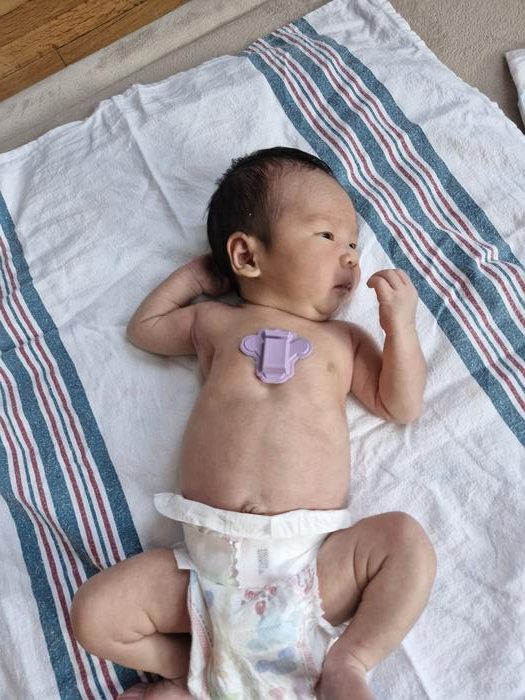
Caption: By continuously monitoring physiological signs of stress, the device can detect underlying stress in individuals, including babies, who cannot communicate.
Credit: John A. Rogers/Northwestern University
How the Device Works
Weighing less than 8 grams — roughly the weight of eight paperclips — the device integrates several miniaturized sensors into a single, flexible platform. A built-in motion sensor and tiny microphone pick up mechanical and acoustic signals from the heart and lungs. Separate sensors measure skin temperature and heat flow tied to near-surface blood circulation. Another tracks changes in the skin’s electrical conductivity driven by sweat gland activity, a long-recognized indicator of the body’s fight-or-flight response.
“Measuring stress is a complex task because it’s multi-dimensional,” added Rogers. “It’s not possible to reliably determine stress by measuring just one or two, or even three or four, parameters. A broad collection of factors is necessary. So, we crammed as many sensors of physiological processes into this device platform as we could, while maintaining a compact size and lightweight construction and avoiding the need to access biofluids.”
The synchronized data streams are processed by machine learning algorithms that identify physiological patterns associated with stress in real time. The device can operate continuously for more than 24 hours — a key advantage for round-the-clock monitoring in clinical and home environments alike.
Tested Across Real-World Scenarios
The research team validated the system across a wide range of conditions. During simulated lie-detector tests, the wearable matched the accuracy of commercial polygraph machines. In cognitive tests — like understanding speech in noisy environments — the device detected rising stress signals as tasks grew harder, results that tracked with simultaneous measurements of pupil dilation, a standard physiological stress indicator.
Participants who submerged their hands in ice-cold water showed coordinated changes across all of the device’s sensors. In pediatric sleep studies, the wearable identified breathing irregularities and nighttime awakenings with accuracy comparable to hospital-grade equipment, while being far less disruptive to patients.
One finding will resonate particularly with college students: during emergency room training sessions with medical students, participants who showed stronger physiological stress responses tended to perform worse on the tasks at hand — suggesting that measurable, body-level stress can quietly undermine decision-making even when a person feels in control.
“Ultimately, the device could send an alert to a user or caregiver when stress levels hit a certain limit,” Rogers added. “Many people might not fully appreciate the level of stress they are under and might not realize it’s affecting their performance.”
What Comes Next
Co-corresponding author Debra E. Weese-Mayer, the Beatrice Cummings Mayer Professor of Pediatric Autonomic Medicine and professor of pediatrics (neurology) at Northwestern University Feinberg School of Medicine, emphasized the device’s potential to change how clinicians and patients understand and respond to stress over time.
“This new device tracks the body’s stress signals around the clock, helping quantify how long someone is stressed each day and how intense that stress is,” Weese-Mayer said in the news release. “The beauty of the device is that both individuals and healthcare providers can now identify stress and objectively monitor the effectiveness of interventions to decrease stress and restore a healthy balance, in a completely non-invasive manner.”
The team plans to test the device in larger patient groups, refine its ability to personalize stress detection for individuals and work toward integrating it into both hospital monitoring systems and at-home use. Rogers is also exploring the possibility of adding electroencephalogram (EEG) sensors to capture brain activity alongside the body’s stress signals — a step that could eventually allow the device to distinguish stress from pain, even outside a clinical setting.
“We are living in stressful times, without sufficient measures to proactively detect stress,” Weese-Mayer added. “By identifying stress — whether environmental or disease-induced — earlier, we can introduce intervention before stress’ effects become irreversible.”
Jae-Young Yoo of Sungkyunkwan University in Seoul, South Korea, is the third co-corresponding author of the study.
Source: Northwestern University