
Researchers have dated complex stone tools from a Chinese archaeological site to 146,000 years ago — during a brutal ice age. The discovery challenges the assumption that human creativity flourishes only in times of plenty.
A cache of stone tools unearthed at an archaeological site in central China is upending assumptions about when and why our ancient relatives became innovators. New research published in the Journal of Human Evolution shows the tools — crafted by an archaic human species — were made roughly 146,000 years ago, during one of Earth’s coldest glacial periods, not during the warmer, resource-rich era scientists previously assumed.
The findings suggest that ingenuity, far from being a byproduct of comfortable living, may have been a survival strategy forged under pressure.
“People often imagine creativity as something that flourishes in good times,” lead author Yuchao Zhao, the assistant curator of East Asian archaeology at the Field Museum in Chicago, said in a news release. “Finding out that these stone tools were made during a harsh ice age tells a different story. Hard times can force us to adapt.”
What Was Found at Lingjing
The Lingjing archaeological site in Henan Province, central China, has been the focus of excavations for more than a decade. The site was once a butchering ground for Homo juluensis, an archaic human species that represents a fascinating evolutionary branch. These ancient relatives of modern humans had exceptionally large brains and displayed a mix of physical traits seen in both eastern Asian archaic humans and European Neanderthals.
Alongside animal bones — many belonging to deer-like species — researchers found disc-shaped stone cores that, at first glance, might seem unremarkable. A closer look revealed something far more sophisticated. Some cores were worked symmetrically on both sides, while others followed a deliberate asymmetrical design: one surface served as a striking platform while the other was shaped specifically to produce sharp-edged flakes. That division of labor within a single stone object points to advanced spatial reasoning and forward planning.
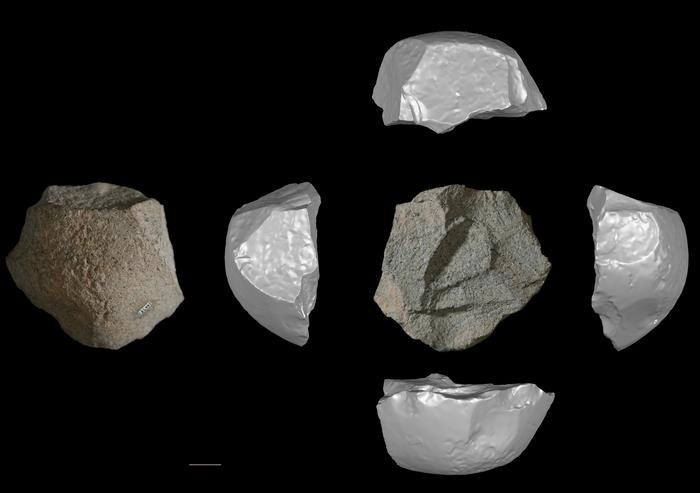
Caption: One of the 146,000-year-old stone cores used to make butcher’s tools, found in Lingjing, China. Photo by Yuchao Zhao.
Credit: Yuchao Zhao
“This was not casual flake production, but a technology that required planning, precision, and a deep understanding of stone properties and fracture mechanics,” Zhao added. “The underlying logic of this system — and the cognitive abilities it reflects — shows important similarities to Middle Paleolithic technologies often associated with Neanderthals in Europe and with human ancestors in Africa, suggesting that advanced technological thinking was not limited to western Eurasia.”
A Natural Clock Inside a Bone
The most striking update to the Lingjing story came not from the stone tools themselves, but from a deer rib buried alongside them. Inside the bone, researchers discovered calcite crystals — minerals that contain trace amounts of uranium, which decays into thorium at a predictable rate. By measuring the uranium-to-thorium ratio in the crystals, scientists were able to calculate when the crystals formed, and by extension, when the bone was buried.
“The calcite crystals inside the bone acted like a natural clock, allowing us to refine the age of the site,” says Zhao.
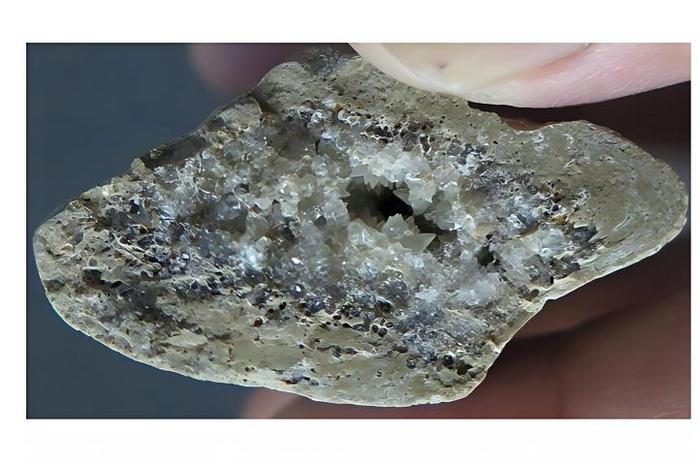
Caption: Crystals growing inside a bone found at the Lingjing archaeological site; these crystals were used to date the site, and the tools found there, to an ice age 146,000 years ago. Photo by Zhanyang Li.
Credit: Zhanyang Li
The previous estimate placed the tools at no more than 126,000 years old — a date that fell within a warm interglacial period. The crystal analysis pushed that date back by roughly 20,000 years, placing the tools squarely in a glacial period characterized by harsh, frigid conditions.
“Even though these tools are just a little bit older than we’d previously thought, the entire story is changed,” added Zhao. “During the Pleistocene, Earth repeatedly shifted between colder ice-age periods and warmer intervals between them. We used to think these tools were made 126,000 years ago, during a warm interglacial period, but based on the new dates suggested by the crystals, some of these tools were actually produced 146,000 years ago, during a harsh, cold glacial period.”
Why It Matters
For decades, archaeologists held that populations in East Asia lagged behind their counterparts in Europe and Africa when it came to technological innovation during the late Middle Pleistocene, roughly 300,000 to 120,000 years ago. The Lingjing tools, now accurately dated, complicate that narrative significantly. They demonstrate that complex, organized stone-tool production was happening independently in East Asia at roughly the same time that similar technologies were emerging elsewhere in the world.
For students studying anthropology, archaeology, evolutionary biology, or even cognitive science, the implications are broad. The capacity for creative problem-solving under stress — something modern students know all too well — may be a deeply ancient human trait, not a product of leisure or abundance.
“Altogether, this research reveals a much richer story of innovation, intelligence, and human evolution in East Asia,” Zhao added.
The research was led by Zhao alongside senior author Zhanyang Li, a professor at Shandong University in China.
Source: Field Museum