
Along the rim of China’s Taklamakan Desert, a 40-year experiment in planting hardy shrubs is slowing desert expansion and quietly soaking up carbon dioxide. New satellite-based research shows even one of the world’s driest places can become a measurable carbon sink.
Along the edge of China’s largest desert, a slow, green transformation is reshaping both the landscape and the atmosphere above it.
A decades-long effort to plant hardy shrubs around the Taklamakan Desert in western China has created a measurable carbon sink in one of the driest places on Earth, according to a new study led by University of California, Riverside scientists and published in the Proceedings of the National Academy of Sciences.
The project, launched by the Chinese government in 1978 to halt the desert’s advance, is now offering rare, long-term evidence that carefully planned greening of barren land — known as afforestation — can help pull carbon dioxide out of the air, even in harsh desert environments.
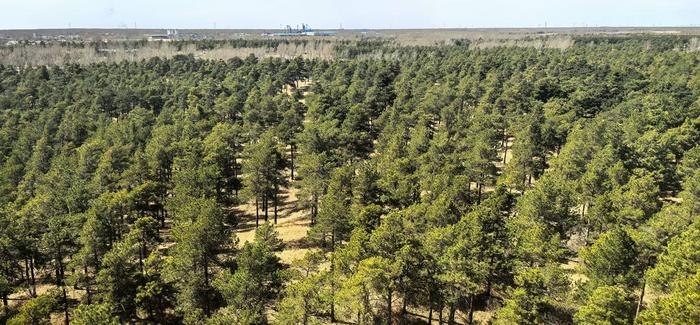
Caption: A successfully afforested area of the desert as it stands with medium-sized trees today.
Credit: (Le Yu/Tsinghua University)
The researchers analyzed multiple years of satellite data over the desert’s rim, where rows of shrubs have been planted for more than four decades. They focused on two key signals: changes in atmospheric carbon dioxide and changes in plant activity.
One satellite, NASA’s Orbiting Carbon Observatory, tracks carbon dioxide concentrations in the atmosphere. Over the greening zone at the Taklamakan’s edge, it revealed a distinct “cold spot” in carbon dioxide, an area where levels are 1 to 2 parts per million lower than in surrounding air.
A second satellite instrument, known as MODIS, measures solar-induced fluorescence — faint light emitted by plants during photosynthesis. Rising fluorescence over the shrublands shows that plant life is now thriving where there was once mostly bare sand.
Co-author King-Fai Li, an associate professor in the Environmental Sciences Department at UC Riverside, emphasized that the new carbon sink is not the lush forest many people picture when they think of climate solutions.
“This is not like a rainforest in the Amazon or Congo,” Li said in a news release. “Some afforested regions are only shrublands like Southern California’s chaparral. But the fact that they are drawing down CO₂ at all, and doing it consistently, is something positive we can measure and verify from space.”
The Taklamakan, roughly the size of Germany, has long posed environmental and political challenges for China. Unchecked desert expansion threatened farmland and contributed to instability in western regions, where minority ethnic groups have clashed with central authorities. Planting shrubs along the desert’s rim was seen as a way to stabilize soils, protect agriculture and, more recently, help reduce the nation’s carbon footprint.
The new study shows that strategy is working — at least to a point.
By combining satellite observations with estimates of plant growth, the researchers concluded that the afforested belt around the Taklamakan is indeed acting as a human-made biospheric carbon sink. If the entire desert were eventually covered with similar shrublands, the team estimates it could offset roughly 60 million tons of carbon dioxide per year, about 10% of Canada’s annual emissions.
That is a meaningful amount for a single region, but tiny compared with global emissions of around 40 billion tons per year. The findings underscore both the promise and the limits of using land-based greening projects to fight climate change.
Li cautioned against viewing desert planting as a silver bullet.
“We’re not going to solve the climate crisis by planting trees in deserts alone. But understanding where and how much CO₂ can be drawn down, and under what conditions, is essential,” he said. “This is one piece of the puzzle.”
Water is the main constraint. The shrubs on the Taklamakan’s rim survive thanks to runoff from nearby mountains, which delivers just enough moisture to keep them alive. Pushing the project deeper into the desert would require a reliable water source — a growing challenge as climate change and overuse strain water supplies worldwide.
The study also notes that afforestation is not a simple “plant and forget” solution. Trees and shrubs absorb carbon as they grow, but they also release carbon dioxide through respiration. The net climate benefit depends on many factors, including soil type, vegetation density and local climate. Poorly planned projects can even backfire, for example by using too much water or displacing native ecosystems.
Still, the Taklamakan experiment stands out because it has endured. Unlike some high-profile but short-lived efforts, such as a United Nations-backed greening attempt in the Sahara Desert, China’s program has continued for decades, supported by political stability and a mix of environmental and economic motivations.
The research also fits into a broader scientific effort to understand all the ways deserts interact with the carbon cycle. Other studies have suggested that desert sand may physically trap small amounts of carbon dioxide as it expands and contracts with daily temperature swings. That mechanism is minor compared with photosynthesis, but it may add up to as much as a million tons of carbon sequestration each year across large desert regions.
Taken together, these findings suggest that even seemingly barren landscapes can play a role in moderating the climate — if managed carefully.
For communities and policymakers searching for climate strategies that do not depend on unproven technologies, the Taklamakan shrublands offer a tangible example of a low-tech, nature-based approach that delivers multiple benefits: slowing desertification, protecting farmland and removing some carbon from the air.
Li sees a broader lesson in the project’s persistence and measurable impact.
“Even deserts are not hopeless,” added Li. “With the right planning and patience, it is possible to bring life back to the land, and, in so doing, help us breathe a little easier.”
Additional co-authors include atmospheric scientist Xun Jiang at the University of Houston, Earth system scientist Le Yu at Tsinghua University in Beijing, and planetary scientist Yuk L. Yung at Caltech.