
Stanford engineers have, for the first time, used AI to help control a robot on the International Space Station. Their work could pave the way for more autonomous helpers on future missions to the moon and Mars.
A toaster-size robot quietly gliding through the International Space Station, dodging laptops and lab gear as it delivers supplies or checks for leaks without an astronaut at the controls, sounds like science fiction. A Stanford-led team has just taken a major step toward making that routine.
Researchers at Stanford University have become the first to show that a machine-learning-based control system can operate a robot aboard the ISS, using NASA’s free-flying Astrobee platform as a testbed. Their work, published in and presented at the 2025 International Conference on Space Robotics, demonstrates that artificial intelligence can help space robots plan safe, efficient paths in the station’s crowded interior.
The result is a milestone for space robotics.
“This is the first time AI has been used to help control a robot on the ISS,” lead researcher Somrita Banerjee, who conducted the study as part of her Stanford doctorate, said in a news release.
Astrobee is a cube-shaped, fan-powered robot that can float through the station’s pressurized modules. The ISS is far from an open warehouse; it is a maze of interconnected compartments packed with computers, storage lockers, wiring bundles and experiment racks. Planning a path that avoids all of that, while staying within strict safety limits, is a hard math problem.
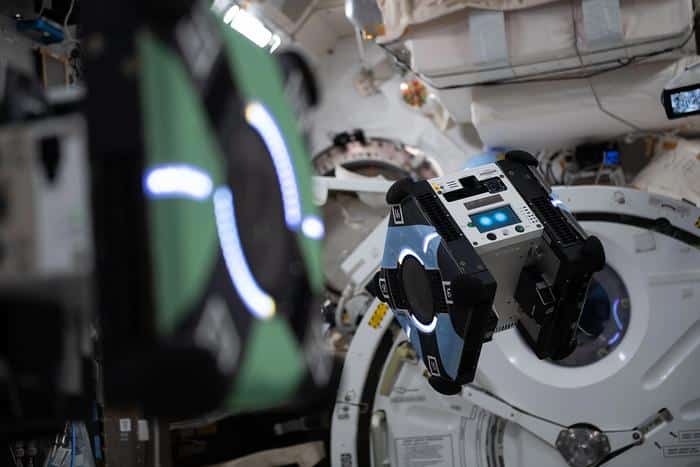
Caption: Astrobee is NASA’s free-flying robotic system. Using Astrobee, Stanford researchers became the first to test AI-based robotic control aboard the International Space Station.
Credit: NASA
On Earth, robots often rely on powerful computers and flexible hardware to crunch through such planning tasks. In orbit, engineers do not have that luxury.
“The flight computers to run these algorithms are often more resource-constrained than ones on terrestrial robots. Additionally, in a space environment, uncertainty, disturbances, and safety requirements are often more demanding than in terrestrial applications,” added senior author Marco Pavone, an associate professor of aeronautics and astronautics in the School of Engineering and director of Stanford’s Autonomous Systems Laboratory.
To navigate that reality, the team built on a classic optimization approach known as sequential convex programming. In simple terms, this method breaks a complicated motion-planning problem into a series of smaller, easier steps, gradually refining a trajectory that is safe and feasible for the robot to follow.
The catch is that solving each step from scratch can be slow, especially on a modest flight computer. That delay limits how quickly a robot can respond to new tasks or changing conditions.
The Stanford group’s key innovation was to give the planner a head start using machine learning. They trained an AI model on thousands of previously computed paths through the station-like environment. Over time, the model learned patterns about where open corridors tend to be and where obstacles usually appear.
When Astrobee is given a new start and end point, the AI suggests an initial guess for the route. The traditional optimizer then takes over, adjusting that guess until it satisfies all safety constraints. In control theory, this kind of informed initial guess is called a “warm start.”
Banerjee likens it to planning a long drive.
“Using a warm start is like planning a road trip by starting with a route that real people have driven before, rather than drawing a straight line across the map,” she said. “You start with something informed by experience and then optimize from there.”
By starting closer to the final answer, the system can converge much more quickly, saving precious computing time without relaxing safety checks.
Before sending their AI system to orbit, the team tested it at NASA’s Ames Research Center on a special testbed that mimics microgravity. A robot similar to Astrobee floated just above a polished granite table, supported by jets of compressed air.
Banerjee described the setup as “It’s like a puck on an air-hockey table,” allowing the robot to glide with very little friction.
Once the system passed ground tests, NASA scheduled an experiment on the ISS. On test day, astronauts performed what the agency calls a “crew-minimal” setup, handling only preparation and cleanup. After that, they floated out of the way while the robot and the AI took center stage.
From Earth, Banerjee sent instructions to ground operators at NASA’s Johnson Space Center in Houston. The operators relayed commands to Astrobee, specifying starting points, destinations and virtual obstacles to avoid. The team ran each trajectory twice: once with a traditional “cold” start, and once with the AI-provided “warm start.”
In total, they tested 18 different paths, each lasting more than a minute. The results were clear.
“We showed that it’s 50 to 60% faster, especially in more challenging situations,” Banerjee added.
Those tougher cases included cluttered areas, tight corridors and maneuvers that required the robot to rotate rather than simply fly straight.
Throughout the experiment, multiple safeguards were in place. Obstacles were simulated in software rather than placed physically, eliminating collision risk. A backup robot stood ready, and operators could abort any run if needed. The AI system always worked within a mathematically rigorous planner that enforced safety limits.
For Banerjee, watching the test unfold in orbit was not just a technical triumph but a personal one.
“The coolest part was having astronauts float past during the experiment,” she added. “One of them was one of my childhood heroes, Sunita Williams. Seeing years of work actually perform in space and watching her there while the robot moved around was incredible.”
NASA has designated the team’s “warm start” system as reaching Technology Readiness Level 5, meaning it has been successfully tested in a relevant operational environment. That status signals to mission planners that the approach is mature enough to be considered low risk for future spaceflight experiments.
Beyond the ISS, the work points toward a future in which robots shoulder more of the routine and hazardous tasks in space, from inventory checks and inspections in orbiting labs to scouting terrain and building infrastructure on the moon or Mars. As missions travel farther from Earth, communication delays make constant human teleoperation impractical.
“As robots travel farther from Earth and as missions become more frequent and lower cost, we won’t always be able to teleoperate them from the ground,” Banerjee added. “Autonomy with built-in guarantees isn’t just helpful; it’s essential for the future of space robotics.”
Pavone’s lab, working through Stanford’s Center for Aerospace Autonomy Research and in collaboration with the Stanford Space Rendezvous Lab, plans to push the idea further. The team is exploring more powerful AI models, similar to those used in modern language tools and self-driving systems, that could generalize to even more complex environments and tasks.
If those efforts succeed, future astronauts may share their spacecraft with a fleet of increasingly capable robotic partners, quietly charting safe paths through the unknown while their human counterparts focus on discovery.
Source: Stanford University