
Researchers at the University of Sharjah have patented an innovative technology that converts spent coffee grounds and plastic waste into a powerful CO₂ adsorbent, offering a dual benefit of reducing emissions and repurposing waste.
Researchers at the University of Sharjah have patented a groundbreaking technology that captures carbon dioxide emissions from industrial processes, potentially providing a significant advancement in the fight against climate change.
The patent, filed in March 2025 and published in August, details a unique method that repurposes spent coffee grounds (SCG) and polyethylene terephthalate (PET), a common plastic used in packaging, along with potassium hydroxide (KOH), to create a robust material for CO₂ adsorption.
This innovative approach addresses environmental pollution and the substantial CO₂ emissions from industrial sources.
“What begins with a Starbucks coffee cup and a discarded plastic water bottle can become a powerful tool in the fight against climate change through the production of activated carbon,” Haif Aljomard, the lead inventor of the patented CO₂ capture technology, said in a news release.
Globally, an estimated 8 million tons of spent coffee grounds are discarded annually, predominantly ending up in landfills where they release methane and other greenhouse gases. By reutilizing this waste, the new method not only captures CO₂ but also supports sustainable waste management.
PET, a widely used material in consumer packaging, becomes part of this eco-friendly solution in combination with KOH, enhancing the activated carbon’s ability to trap carbon. This advancement is a significant milestone in developing eco-friendly technologies aimed at mitigating climate change.
Aljomard explained that the innovation involves producing activated carbon through the co-pyrolysis of spent coffee grounds and polyethylene terephthalate plastic waste at an environmentally friendly activation temperature of 600°C.
“This invention repurposes two abundant waste streams — coffee and plastic — into a high-performance adsorbent,” she added. “The resulting activated carbon shows strong potential for capturing CO₂ from fossil fuel-based energy systems, contributing to the reduction of air pollution.”
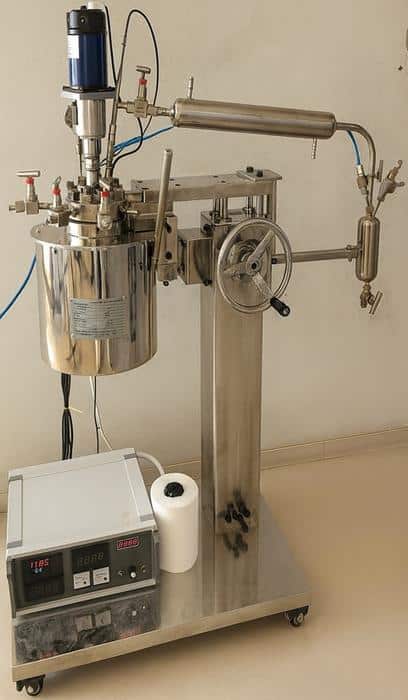
Caption: Reactor driving the carbonization of coffee and plastic waste into high-performance carbon.
Credit: University of Sharjah
The inventors report that their method yields activated carbon with high CO₂ adsorption capacity, making it suitable for various industrial applications. They underscore the low production costs, thanks to the affordable and readily available raw materials.
“This invention exemplifies circular economy principles by integrating waste streams for dual valorization and upcycling into valuable products,” added co-inventor Chaouki Ghenai, a professor in the Sustainable and Renewable Energy Engineering Department at the University of Sharjah. “Transforming spent coffee grounds and plastic waste into high-quality activated carbon offers economic, social, and environmental benefits.”
The potential applications of this technology span multiple industrial sectors, including water and air treatment, food processing, chemical engineering and energy systems. The researchers believe it could significantly reduce environmental impact across various domains.
As the patent transitions from academia to industrial deployment, the researchers are optimistic about its practical capabilities. They envision its use in gas and water purification, pollutant removal, emission control and even energy sector applications, such as natural gas purification and flue gas cleaning.
“There is an urgent need for effective and sustainable technologies to capture and reduce CO₂ emissions from sources such as fossil fuel combustion, industrial processes, and power generation,” concluded the researchers in their patent document, underscoring the pressing necessity of such innovative solutions.
Source: University of Sharjah