
Researchers from the University of Leeds and UCL have created an AI system enabling a four-legged robot to autonomously adapt its gait to varied terrains, promising significant advancements in hazardous situation management.
Researchers at the University of Leeds and University College London (UCL) have developed an AI system that allows a four-legged robot to adapt its gait to a multitude of terrains, mimicking the agility and adaptability of real animals.
This monumental development, detailed in a paper published today in Nature Machine Intelligence, is poised to revolutionize how legged robots are deployed in complex, hazardous environments.
The project team drew inspiration from animals like dogs, cats and horses, which naturally adjust their gait to save energy, maintain balance and respond to threats.
This new AI framework enables the robot, nicknamed “Clarence,” to autonomously transition between walking, trotting, running and bounding. This sophisticated gait adaptation was achieved in a remarkably short nine-hour training period.
“Our findings could have a significant impact on the future of legged robot motion control by reducing many of the previous limitations around adaptability,” first author Joseph Humphreys, a postgraduate researcher in the School of Mechanical Engineering at Leeds, said in a news release.
Adaptable and Intuitive
Traditionally, robots required explicit programming to handle different terrains.
However, Clarence’s AI allows it to make real-time decisions about its movements without human intervention, similar to how animals instinctively navigate their environment. This marks a significant leap in robotics, addressing one of the major limitations of previous systems: adaptability.
“All of the training happens in simulation. You train the policy on a computer, then take it and put it on the robot and it is just as proficient as in the training,” added Humphreys. “We then tested the robot in the real world, on surfaces it had never experienced before, and it successfully navigated them all.”
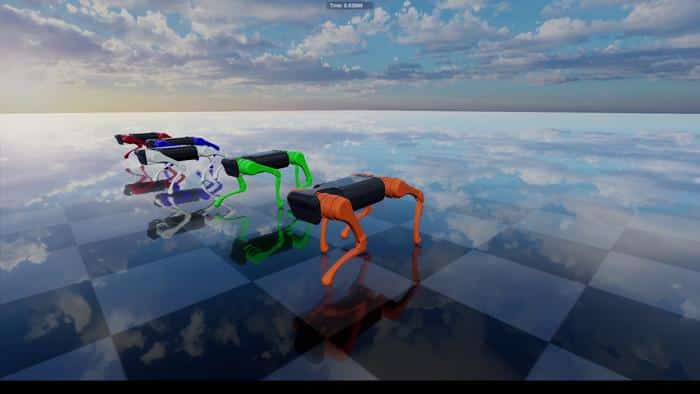
Caption: Robot learning to adapt its gait to simulated terrain. It simultaneously practised within hundreds of simulated environments.
Credit: Joseph Humphreys, University of Leeds
Senior author Chengxu Zhou, a professor in the Department of Computer Science at UCL, emphasized the novelty and potential of this development.
“This research was driven by a fundamental question: what if legged robots could move instinctively the way animals do? Instead of training robots for specific tasks, we wanted to give them the strategic intelligence animals use to adapt their gaits — using principles like balance, coordination and energy efficiency,” he said.
Real-World Applications
The possible applications for this technology are extensive.
Robotic systems equipped with such adaptive capabilities could be used in search and rescue missions, nuclear decommissioning, planetary exploration, agriculture and infrastructure inspection.
This breakthrough points to a future where robots can handle real-world challenges with the same fluidity as biological entities.
“By embedding those principles into an AI system, we’ve enabled robots to choose how to move based on real-time conditions, not pre-programmed rules,” Zhou added. “That means they can navigate unfamiliar environments safely and effectively, even those that they haven’t encountered before.”
Future Prospects
Looking ahead, the research team aims to further enhance Clarence’s capabilities, including long-distance jumping, climbing and navigating steep or vertical terrains.
While the framework has only been demonstrated on a single dog-sized quadruped in this study, its core principles and bio-inspired metrics are widely applicable to other four-legged robots of similar morphology, regardless of their size or weight.
Source: University of Leeds