
A new study from Emory University shows that children as young as five can navigate a virtual environment, revealing early development of critical brain systems. This breakthrough could reshape our understanding of cognitive development.
In a groundbreaking study, researchers at Emory University have discovered that children as young as five years old can navigate through a virtual environment dubbed “Tiny Town,” demonstrating that they possess advanced map-based navigation skills much earlier than previously believed.
By using brain scans and a simplified virtual environment, the researchers identified that the neural system supporting this type of navigation is in place by age five.
Their findings, published in the Proceedings of the National Academy of Sciences, challenge the prevailing notion that such skills fully develop around age 12.
“While large-scale navigation abilities certainly continue to develop throughout childhood, our findings show that the underlying neural system is established remarkably early,” first author Yaelan Jung, a postdoctoral fellow in Emory’s Department of Psychology, said in a news release.
“Rather than taking a decade or more, map-based navigation is underway in half that time,” added senior author Daniel Dilks, an associate professor of psychology at Emory. “Five-year-olds have the brain system enabling them to find their way around a tiny, virtual town. They not only know that the ice cream store in the mountain region is different than the ice cream store in the lake region, they know how to navigate the streets to get to each of them.”
The study’s implications stretch beyond academic curiosity; it suggests early development of cognitive abilities that were previously underestimated. The research has the potential to inform educational strategies and identify early indicators of atypical neural development, paving the way for interventions.
In prior studies with adults, the Dilks lab has distinguished the functions of three scene-selective brain regions: the parahippocampal place area (PPA) for recognizing places, the retrosplenial complex (RSC) for mapping locations, and the occipital place area (OPA) for navigating immediate surroundings.
One might find it counterintuitive that while children can walk before age two, their brain systems for walking navigation don’t resemble those of adults until about age eight.
“Most children can walk before the age of two. And yet the brain system helping you walk around your immediate surroundings doesn’t start appearing adultlike until relatively late,” Dilks added.
Jung and Dilks theorized that the seemingly complex ability of map-based navigation develops earlier due to the environmental exposure toddlers get when they are carried or pushed in strollers.
To test their theory, they ran experiments using a virtual environment initially designed for adults, called Neuralville, which was then simplified to Tiny Town. Tiny Town features a triangular layout with distinctive landmarks, such as mountains, trees and lakes, making it suitable for five-year-olds.
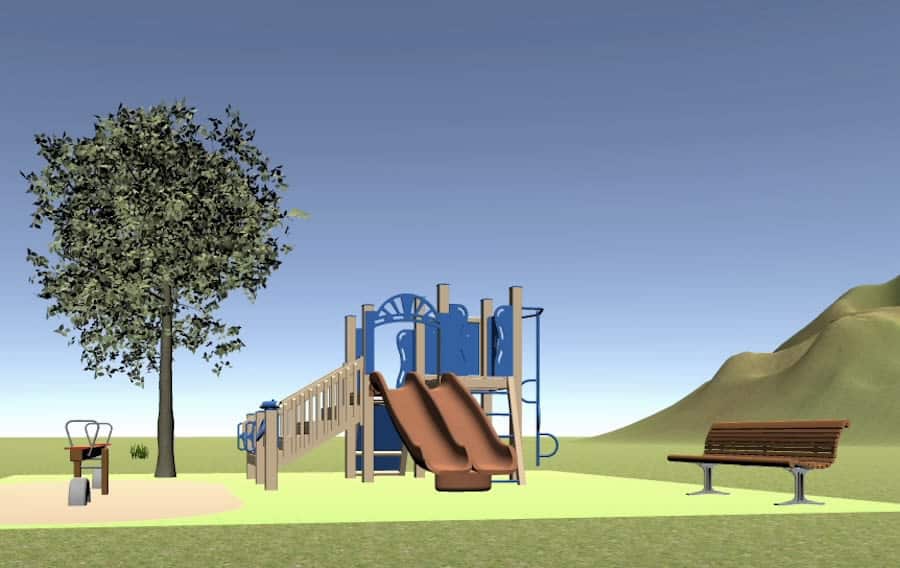
Caption: A playground scene in Tiny Town
Credit: Dilks Lab, Emory University
The children were introduced to Tiny Town through computer games and trained to navigate it, subsequently being tested on their memory and map skills using fMRI scans.
The experiment’s success also highlighted the importance of making science engaging for children.
“We want to get at the scientific questions that we’re trying to answer,” added Jung, “but it’s also important that a child who participates in a study has a good time. We want them to leave with a good impression of science.”
Looking to the future, the Dilks lab is now focusing on even younger age groups to further understand the development of these complex brain functions.
“It’s fascinating to explore how humans use different parts of the brain for complex behaviors and how these different neural systems come online in development,” Jung added.
This continuing research aims to deepen our understanding of typical and atypical neural development.
Source: Emory University