
A new national poll from the University of Michigan Health C.S. Mott Children’s Hospital reveals that one in six parents support non-surgical cosmetic procedures for teens with parental consent. Learn more about the evolving perspectives and concerns parents have regarding aesthetic treatments for their children.
A growing trend has emerged among parents showing increased support for teenagers seeking non-surgical cosmetic procedures. According to a new national poll conducted by the University of Michigan Health C.S. Mott Children’s Hospital, one in six parents believe that teens should be allowed to receive these types of aesthetic treatments, provided there is parental approval.
For many teens grappling with issues such as acne scars or discolored teeth, non-surgical cosmetic procedures present a viable solution to improve their self-image. The nationally representative survey, which included responses from 989 parents of children aged 13-17, sheds light on the diverse parental perspectives concerning this issue.
While a significant fraction of parents are open to such procedures, conditional support is more common. Approximately half of the surveyed parents approve of non-surgical cosmetic treatments if there is a “valid reason,” though opinions vary on what constitutes a valid reason.
“Parents were conflicted about the circumstances under which non-surgical cosmetic procedures are appropriate for teens,” Susan Woolford, M.D., a Mott Poll co-director and pediatrician, said in a news release. “Interestingly, similar proportions of parents rated the validity of teens wanting to look good for a special occasion on par with wanting the procedures due to mental health or bullying.”
Notably, around a third of the parents support teens resorting to cosmetic enhancements, like laser hair removal, chemical skin peels, teeth whitening and dermal fillers for special occasions, such as prom or graduation ceremonies.
The Digital Age Influence
The surge in interest among teens for cosmetic procedures can be partially attributed to the influence of social media. Platforms often expose adolescents to idealized and digitally altered images, exacerbating insecurities about their natural appearance.
“Teens are susceptible to feeling insecure about their appearance when compared to digitally altered pictures depicting an appearance that is probably unattainable naturally,” Woolford added. “This problem is exacerbated by the pressure to post pictures of themselves to garner validation.”
Woolford also emphasized the need for parents to help their teens understand these media distortions and to carefully explore their motivations for wanting to undergo cosmetic changes.
Health and Safety Concerns
Despite the growing acceptance, many parents express legitimate concerns about the safety and long-term impact of non-surgical cosmetic procedures.
A considerable number worry that their child might regret the procedure or become inclined to desire more interventions in the future. Additionally, there are fears regarding possible complications, such as scarring, infection or allergic reactions.
“Non-surgical procedures may have fewer risks than surgery but that doesn’t mean they’re risk-free,” Woolford added. “When considering cosmetic procedures, it’s important for parents and teens to be well informed so they can have realistic expectations about what the procedure will actually achieve and if it’s worth the risk.”
Woolford recommends thorough research and consultation with health care professionals to understand the risks, benefits and safety protocols associated with cosmetic treatments.
Divergent Views on Age Appropriateness
The poll also reveals differing opinions on the age at which teens should be allowed to seek such services.
Over half of the parents believe the appropriate age is 18 or older, while 27% consider ages 16-17 to be sufficient and 17% think 15 or younger is acceptable. Nonetheless, nearly one-third of parents feel that teens should be prohibited from undergoing these procedures under any circumstances.
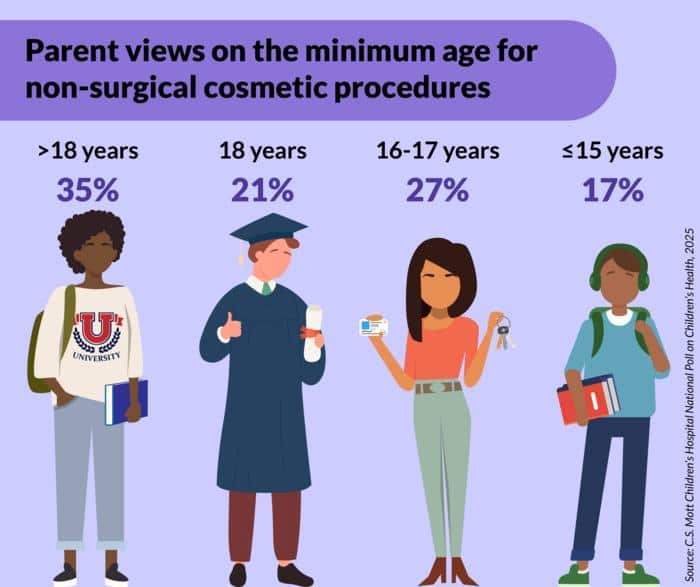
Credit: Sara Schultz, University of Michigan Health C.S. Mott Children’s Hospital National Poll on Children’s Health
As societal norms evolve and the prevalence of social media continues to shape perceptions of beauty, this poll underscores the complexities parents face in navigating cosmetic procedures for their teen children. It highlights the need for open discussions about motivations, expectations and the potential implications for teens considering aesthetic treatments.