
A new study has unveiled a “life oasis” in China’s Turpan-Hami Basin that harbored resilient terrestrial plants during the end-Permian mass extinction. This significant discovery challenges previous assumptions and underscores the critical role of geographical refugia in ecological recovery.
In an inspiring breakthrough, scientists have uncovered a remarkable “life oasis” in China’s Turpan-Hami Basin that provides new insights into how terrestrial plants survived the catastrophic end-Permian mass extinction. This discovery challenges previously held beliefs about the impact of the extinction on terrestrial ecosystems, which traditionally were thought to have suffered dramatically alongside marine life.
Published in the journal Science Advances, the research was led by Liu Feng, a professor in the Nanjing Institute of Geology and Palaeontology (NIGPAS) of the Chinese Academy of Sciences. The team’s findings offer the first conclusive fossil evidence of a stable terrestrial plant community that weathered the extinction event without severe disturbances, allowing for rapid ecological recovery post-catastrophe.
The end-Permian mass extinction, which occurred approximately 252 million years ago, eradicated over 80% of marine species. However, the extent of its impact on terrestrial ecosystems has long been a topic of debate.
One theory suggests severe volcanic eruptions in Siberia caused widespread damage through wildfires and toxic gases. Conversely, another perspective posits that these catastrophic effects were restrained by latitude and atmospheric circulation.
By examining the South Taodonggou section in Xinjiang, Liu’s team has added compelling evidence to the latter argument.
Detailed fossil analysis, combined with advanced dating methods developed by Yang Wan, a professor at the Missouri University of Science and Technology, unveiled a continuous record of thriving riparian fern fields and coniferous forests from 160,000 years before until 160,000 years after the extinction event.
“The presence of intact tree trunks and fern stems further confirms that these microfossils represent local vegetation, not transported remnants,” Wan Mingli, a NIGPAS professor, said in a news release.
While some species were locally eradicated, the researchers concluded that the overall extinction rate of spore and pollen species in this unique area was significantly lower than the marine extinction rate. This was evident by the presence of “missing” species in Early Triassic strata elsewhere, suggesting these plants had temporarily migrated rather than faced complete extinction.
Fossil records indicate that within just 75,000 years after the extinction, the area supported diverse tetrapods, including herbivorous Lystrosaurus and carnivorous chroniosuchians, pointing to a rapid re-establishment of complex food webs. This greatly contrasts with prior estimates that such recovery would exceed a million years.
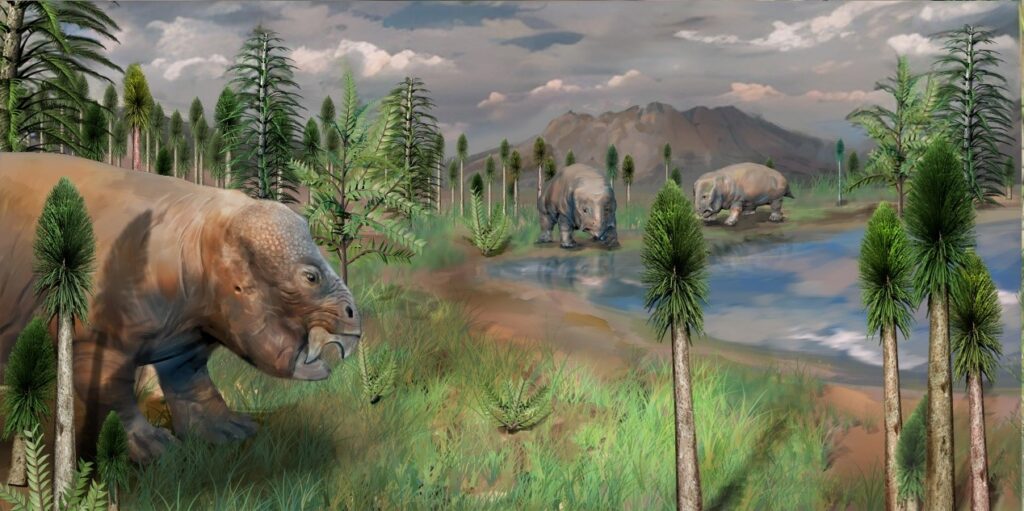
Caption: Artistic reconstruction of the terrestrial ecological landscape before the end Permian mass extinction based on fossil palynomorphs, plants and tetrapods recovered, as well as sedimentological data from the South Taodonggou Section
Credit: YANG Dinghua
The team attributes this exceptional biological resilience to the region’s stable, semi-humid climate. Analysis of paleosol matrices indicated that the area consistently received about 1000 millimeters of rainfall per year. This continuous precipitation created an environment with abundant vegetation, making South Taodonggou a hospitable refuge during and after the mass extinction.
Despite its proximity to the catastrophic volcanic activity that marked the end-Permian period, the Turpan-Hami Basin provided a sanctuary for terrestrial life.
“This suggests that local climate and geographic factors can create surprising pockets of resilience, offering hope for conservation efforts in the face of global environmental change,” added Liu.
In the context of modern concerns over the potential sixth mass extinction driven by human activities, this discovery underscores the critical importance of identifying and preserving such natural refugia. The study was supported by multiple grants, including from the National Natural Science Foundation of China and the US National Science Foundation.
Source: Chinese Academy of Sciences
,